

Northern Patagonia: Chile & The Ruta Araucaria Australes
- Molly Goldstein
- Mar 17
- 5 min read
Updated: 4 days ago

March 4 -14, 2026
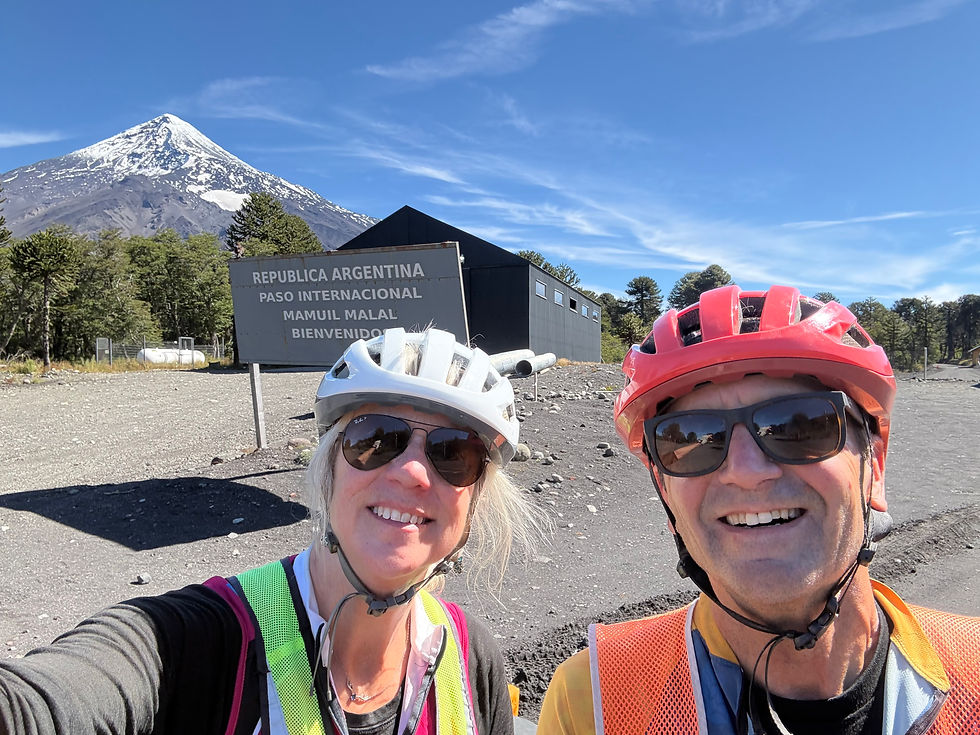
We had finally crossed the Mamuil Malal Pass—the crossing we’d been hoping to make a year earlier on our last trip to Patagonia—but we couldn’t due to wildfires. The Araucaria trees and the views of Volcán Lanín were spectacular. Now we were heading down into the northern part of Chilean Patagonia. The road dropped steeply and steadily toward the indigenous town of Curarrehue, where we spent the night.
The next day we pushed on to the fun lakeside town of Pucón—great restaurants, pubs, and plenty of beers! On the way, I hit 10,000 miles on my odometer—just in one and a half years!
While we stayed a couple of nights in this wonderful resort town, we decided to adventure farther north than we had been before. We planned to visit Conguillo National Park, known for its Araucaria forests and recently active volcanoes.
Our route took us along the southern shore of Lago Villarrica before swinging north.
We spent the night in a really cool little cabin overlooking a stream on land owned by a farmer along Ruta 69, near a tiny community called Pedregoso. We were surrounded by sheep, cows, dogs, and beautiful, bucolic peace and quiet.

The next morning, we began a rough climb over steep gravel until we dropped into the next valley. From there, we headed northeast, back toward the Andes and the town of Melipeuco. Just after town, we turned and climbed up to the entrance of Conguillo National Park, where we stayed again in a tiny cabin on land owned by a local Mapuche family.
Their very friendly family dog became quite pleased when I dropped my sweat-soaked leather riding gloves on the ground near the cabin—and quickly absconded with one of them as a snack for a great evening. I was glad I’d packed an extra pair!
The next day began a two-day ride through Conguillo National Park that felt akin to riding on the moon. The park encompasses one of Chile’s largest and most active volcanoes. It has erupted on a large scale 4–5 times since the 1600s, with the most recent major eruptions in 1994 and 2008.
The winds howled across the open plain of ash and lava at the base of the mountain, blowing us around along the 22 miles of rough gravel road—but the views were amazing. On the second day, we left the barren volcanic landscape and entered verdant forests with crystal lakes, then moved into ancient Araucaria forests. There is nothing like them. We were so glad we’d ridden up here just to see these trees.
To exit the park, we had to climb about 3,000 feet. Unfortunately, the road went from ridable gravel to something more like a steep, river-washed gully. We had to dismount a few times and hike our bikes. The road was too much for Andy’s rear rack: it had already lost a screw, but now both struts snapped in two and the rack could no longer hold his pannier.
We couldn’t have been in a worse place. Over the past two days, the number of cars we’d seen in the park could be counted on two hands—we basically had the entire park to ourselves. That meant we were facing at least 10 miles of rough road with no way to carry the heavy pack.
Andy valiantly tried for about 500 feet, but soon realized there was no way he could carry it. We only wished a car would pass so we could stop it and ask if they’d mind carrying his bags to the entrance of the park, where we hoped to find help.
And then, as if by miracle, a car came by. It was a pickup truck loaded with a family of five packed into the cab. They stopped and tried to understand Andy’s explanation in Spanish—until the teenage girl in the back, Valentina, said, “Do you speak English?” Amazing.
Valentina translated what was happening to her parents, and they were more than happy to help. They took Andy’s bags into the already tightly packed cab and drove not only to the park entrance, but another 10 miles beyond to the cabin where we were staying that night. Valentina and her family will always be remembered by both of us as guardian angels.
The cabin we stayed at was near the intersection of the road to Conguillo and Ruta 181, which runs east–west up to the Argentine border. It was known as Donde José. It was a restaurant, campground, and cabins run by a wonderful Chilean family.
Donde José—who also happened to be a welder—had heard about our situation from the family that dropped off our bags. He volunteered to try to weld the rack back together. Later, the family even celebrated their patriarch’s birthday by sharing their birthday cake with us!
To keep as much weight off what we worried would be flimsy patching of the bike rack, we left our panniers at Donde José for a few days while we biked eastward into more Araucaria forests and volcanoes in the Malalcahuello–Nalcas National Park. We planned to return to Donde José later when we came back, as we headed toward our final destination: the large city of Temuco in central Chile, where we would fly home.
Taking only the bare essentials in our handlebar bags and our rear-seat bag, we biked up a beautiful valley toward the Andes one last time.
Malalcahuello–Nalcas National Park is dominated by two recently active volcanoes: Lonquimay and Tolhuaca. Araucaria trees thrive along the higher elevations on the flanks of these huge volcanoes. We stayed at an isolated ski resort surrounded by trees, with Volcán Lonquimay right there in front of us. It may have been the most spectacular place we’d ever been in all of our travels. To make it even more magical, the resort was basically to ourselves.
We took the next day off our bikes and did a fantastic hike through the Araucaria forests up a ridge that overlooks the volcanoes and the surrounding landscape. It was a beautiful day—and again, we had the place to ourselves.
The next day, we decided to ride further into the national park to a lookout about eight miles up the gravel road along the flank of the volcano, before heading back down and west toward Temuco. The views along that little jaunt were stunning.
That afternoon, we rode back to Donde José’s, where we were greeted by the entire family. They served us some of the best empanadas before sending us on our way. They were such a wonderful family, and we were grateful for their hospitality and friendship—another example of Chilean angels.
We had only a short two-hour ride left from Donde José’s to the town of Curacautín, where we planned to spend the night. Unfortunately, within about half an hour, the weld Don José had made on the rack/frame broke again. Andy stacked things as precariously as possible on his back, and we continued on to Curacautín.
Because the route was mostly on pavement and mostly downhill, we were able to make it there. That evening, we sought out a bike repair shop in town. There was one: Casa Llaima, run by Senor Rambo—a burly ball of positive energy. His shop was rudimentary and he had no real merchandise, but he agreed to help us.
With great ingenuity and engineering, he fixed the rack enough to get us to Temuco the next day. He worked for about an hour and refused to accept any pay for his labor. He was a true gentleman—and another of our Chilean angels we’d met that week.
Our last day of riding took us back toward the central plain that runs north–south from Santiago to Puerto Montt, between the Andes to the east and the coastal hills to the west. We wound through beautiful countryside and farmland until we reached the urban area of Temuco to pack up our bikes and start our flight home.


Comments